|
|
. . 
|
||||||
|
February 08, 2006
© 1998 - 2006 Copyright & |
Body design
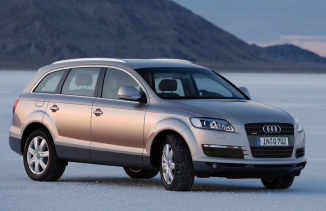
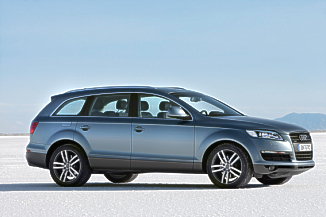
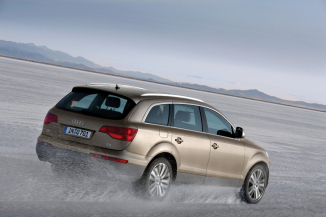
The Audi Q7 measures 5,086 millimetres in length and has a wheelbase of 3,002 mm. These dimensions give it the lead in the SUV contest. Some 1,983 mm wide and 1,737 mm high, it provides incomparable spaciousness for its passengers. It also offers a new dimension in versatility: no less than 28 seating and loading configurations are possible in the Audi Q7. Up to seven people can be accommodated in three rows of seats. The seats in the second row can be individually adjusted for fore/aft movement if desired; here passengers will find the longest legroom in this class. Both rear seat rows can be folded flat to provide a luggage area of 2,035 litres if required, without the seats having to be removed. As a 5-seater version the Audi Q7 boasts a load capacity of 775 litres - the best in its class. The 6-seater is fitted with two luxurious individual seats in the second row. Engine range When the Audi Q7 is launched, customers will have the choice of two powerful engines: the new 4.2-litre V8 with FSI petrol direct injection develops 257 kW (350 bhp) and achieves a maximum torque of 440 Newton-metres, available at 3,500 rpm. The 3.0 TDI six-cylinder engine uses a latest-generation common rail injection system with piezo inline injectors. In this way it combines its high performance of 171 kW (233 bhp) and powerful torque of 500 Nm - available from just 1,750 rpm - with high refinement and excellent economy. Also new is the 3.6-litre FSI, a V6 petrol engine, developing 206 kW/280 bhp and 360 Nm of torque, the latter remaining constant from 2,500 to 5,000 rpm. This engine can be ordered for the Audi Q7 starting from the second half of the year. Power transmission for all three engine versions comes from a 6-speed tiptronic with manual shift option. Like the Audi RS 4 and the Audi S8, the Audi Q7 features the latest-generation self-locking differential with asymmetric/dynamic torque split. The standard split between front and rear axle is 40 : 60. Also thanks to virtually balanced axle load distribution, this technology engenders slightly sporty, tail-heavy characteristics, even better agility and steering precision that remains practically free of torque steer. Suspension
The chassis of the Audi Q7 excels with its sophisticated all-round qualities. All four wheels are suspended independently in an elaborate double wishbone construction. Most of the axle components are made of aluminium. The steel-spring suspension and twin-tube shock absorbers are designed for sporty driving and superior comfort, even off-road. The tilted position of the rear spring and shock absorber unit reduces overall height and creates more room at the rear. Operation and assistance systems High-tech components in the new Audi Q7 are by no means restricted to drivetrain and suspension - they also feature in the controls. The Audi Q7 is equipped as standard with the innovative MMI operating concept - much praised on the A8 and A6. It can be extended in two stages to include a variety of additional functions. A number of innovative driver assistance systems, introduced for the first time in standard production, are available on request. These include Audi side assist with radar technology for lane-changing manoeuvres, the Audi parking system advanced with optical and acoustic guidance and rear-view camera and the latest-generation Audi cruise control with braking guard, which decelerates the Audi Q7 and brings it to a standstill if required. Delivery of the new Audi Q7 will commence in the first quarter of 2006. The basic price of the Audi Q7 3.0 TDI in Germany is 48,900 euros; the list price of the Audi Q7 4.2 FSI is 64,900 euros. Photos: Audi (Feb. 06, 2006)
|
|||||