

Automotive Intelligence - the web for automotive professionals and car enthusiasts
November 28, 2007
This Week:
-
General Motors and Government of Dubai to Bring Hybrids to the Middle East
-
Victory for Audi in the Michelin Challenge Bibendum for the cleanest diesel in the world
-
Mercedes-Benz honors its world best after-sales team at Global TechMasters
-
Tribute to a Porsche Classic - Boxster RS 60 Spyder in Limited Edition
© 1998 - 2007
Copyright &
Disclaimer
Automotive Intelligence,
www.autointell.com
All Rights Reserved .
For questions please contact
editor@autointell.net
|
Victory for Audi in the Michelin Challenge Bibendum for the cleanest diesel in the world
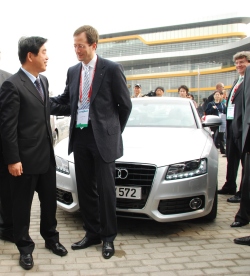
Ingolstadt - The TDI has again demonstrated its superiority as an engine concept that combines efficiency, low emissions and dynamic performance. In the Michelin Challenge Bibendum, the world's leading test and showcase event for sustainable mobility, the Audi A5 3.0 TDI with ultra low emission system finished first in the prototype vehicles category – ahead of a strong field of competitors, many of them vehicles with hybrid drive or powered by fuel cells. The three vehicles entered by Audi scooped a total of nine awards. |
|
|
|
The Challenge Bibendum Rally, which this year was staged in the Chinese metropolis of Shanghai, was the context in which consumption, emissions, driving safety and handling characteristics were all assessed. After all its qualities had been taken into account, the Audi A5 3.0 TDI emerged ahead of its challengers. It came out on top in the categories Handling, Acceleration and Emissions. |
This achievement was squarely attributable to the technology that makes the TDI the cleanest diesel in the world – its ultra low emission system. Though the Audi A5 was entered in the Prototypes category in Shanghai, this system is virtually ready to go into production: the Audi A4 and Audi Q7 will be the first car lines to feature the 3.0 TDI with ultra low emission system, due to go on sale in 2008 in Europe and the USA.
Various engine measures optimise the combustion process and with it the untreated emissions; an exhaust after treatment system cuts nitrogen oxide emissions by up to 90 percent. The new high-tech TDI engines already comply with the emission limits that will probably apply in Europe from 2014, and satisfy the toughest emission limits in the world – the LEV-II BIN-5 standard that applies in five US states.
The Audi A3 Sportback 1.9 TDI e demonstrated in the Michelin Challenge Bibendum just how efficient the standard TDI models of the brand with the four rings already are: its consumption was clocked there at an average of 3.78 litres per 100 kilometres. Audi presented the prototype A6 Avant 2.7 TDI, with yet more near-series technology on board in the form of two intelligent energy management modules. A microhybrid recovers energy during braking and freewheeling, and a start-stop system switches the engine off at traffic lights. The V6 diesel that propels the large Avant with 132 kW (180 bhp) of power thus achieved an excellent average fuel consumption of 4.68 litres per 100 km. The Audi A5 3.0 TDI with ultra low emission system achieved a reading of 5.79 litres/100 km. In view of its very dynamic performance, this too is an excellent figure.
Photo: Audi
(Nov. 22, 2007)
| .
Homepage News Companies Management Publications Events Guestbook Search . |