

Automotive Intelligence - the web for automotive professionals and car enthusiasts
October 17, 2007
This Week:
-
Living smart: smart bolsters market launch in the US with a unique concept in L.A.
-
2008 BMW ALPINA B7 - The Exclusive Ultra-Performance Luxury Sedan
-
Volkswagen Group in China targeting 900,000 vehicles in 2007
-
The New Impreza WRX STI Will Debut at the 2007 Tokyo Motor Show
© 1998 - 2007
Copyright &
Disclaimer
Automotive Intelligence,
www.autointell.com
All Rights Reserved .
For questions please contact
editor@autointell.net
|
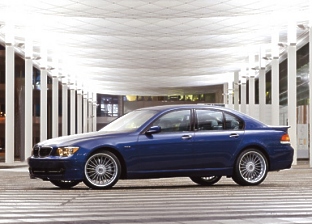
2008 BMW ALPINA B7 - The Exclusive Ultra-Performance Luxury Sedan
Woodcliff Lake, New Jersey - BMW and ALPINA have long had a history of working together to produce special BMW automobiles. Burkard Bovensiepen, son of the founder of ALPINA Business Machines and an enthusastic racing driver/engineer, began his automotive career path in 1961 by developing a dual-carburetor setup for the just-introduced BMW 1500 sedan. It was a predictive beginning: to take an already fine-performing BMW (which also just happened to be a practical sedan) and making it perform even better.
|
|

|
|
By 1964, BMW had officially recognized ALPINA’s contribution to BMW performance and offered warranty coverage on ALPINA-equipped BMW vehicles. Not long thereafter, Burkard Bovensiepen founded the ALPINA company – ALPINA Burkard Bovensiepen KG – that continues today, creating special versions of BMW automobiles that offer a particular brand of performance for discriminating auto enthusiasts. Yet outside the circle of dedicated BMW enthusiasts, ALPINA has kept a low profile in North America. |
In addition to racing versions of BMW, ALPINA has developed a progression of BMW-based cars based on 3, 5, 6, 8, Z4 and Z8 models and offered them on a limited-production basis. Up to now, the only BMW ALPINA model offered by BMW of North America has been the 2003 ALPINA ROADSTER V8, a special interpretation of the Z8 Roadster of which 450 examples were delivered to U.S. customers.

The latest manifestation of the unique BMW-ALPINA synergy is the B7, based on the BMW 7 Series luxury sedan. Currently, BMW offers ultra-performance models of its 3, 5, 6 and Z4 Series developed by BMW M, BMW’s own performance subsidiary. BMW M’s automobiles have specific performance character, typified by high-revving engines and manual or sequential-manual (SMG) transmissions. For an ultra-performance version of the 7 Series – a platform that is defined by lavish luxury and generous interior space and offered only with an automatic transmission – something other than “M” performance character was called for.
In recent models, ALPINA has concentrated on delivering very high levels of performance with moderate rpm ranges and automatic transmission. Most appropriately, the new BMW ALPINA B7 applies this philosophy to the 7 Series to produce a luxury sedan of stunning performance. “A 7 Series Beyond,” one might say.
ALPINA B7: a “7” of unique character
BMW itself offers a 7 Series model powered by a 438-horsepower V-12 engine, the 760Li. It is indeed a high-performance car, combining the velvety and high-torque power delivery of a 12-cylinder engine with ultimate luxury. For an unabashedly sporty interpretation of the 7 Series, ALPINA chose the path of supercharging BMW’s V-8 engine.

By selecting as the basis for the B7 the BMW 750i, with its V-8 engine and regular-wheelbase platform, ALPINA could achieve a vehicle weight some 400 pounds lighter than that of the 760Li – a benefit in terms of agility and maneuverability. Then, to attain a power target of 500 hp, ALPINA added a supercharger to the V-8 engine, which adds little weight but lots of horsepower.
And, where the rubber meets the road, ALPINA topped even the 2006 BMW 760i’s standard 20-in. wheels and tires by upping it to 21 inches. Right from the days of its participation in developing the lightweight BMW 3.0 CS of the early 1970s, ALPINA has a long tradition of radial-spoke wheels; this carries on in the B7’s massive 21 x 9.0-in. front and 21 x 10.5-in. rear wheels with a traditional count of 20 slender spokes. These provide for outstanding ventilation of the big brake rotors, and carry Z-rated performance tires of 245/35 front / 285/30 rear dimensions.

One “final” B7 measure, adoption of the 760Li final drive, completes ALPINA’s powertrain and chassis development. ALPINA engineered some strengthening modifications to this differential unit, which have now flowed into BMW’s own production of that model. And yet even with this strengthening, the supercharged V-8’s torque is so massive that it is electronically limited in the transmission’s bottom two gears.
Photos: BMW
(October 15, 2007)
| .
Homepage News Companies Management Publications Events Guestbook Search . |